CONFRONTING CARBON MAJORS. GHOST UNIT. SUPPLY CHAIN LAW SELLOUT

SEPTEMBER 2025 | NEWSLETTER 106

Public attention in the Global North may have shifted away from the urgency of the climate crisis compared to years past, but the summer months never fail to remind us relentlessly of its presence. As wildfires and heatwaves make the threat palpable for many once again, inaction at the highest levels of politics appears increasingly indefensible. However, as we enter the fall season, the landscape of climate justice in Europe – and globally – has shifted in significant and encouraging ways: recent court decisions could open the door to more forceful action against climate injustice.


In June, the International Court of Justice (ICJ) published a landmark advisory opinion on the obligations of states with respect to climate change. And just two weeks ago, residents of Pari, Indonesia – whose island and livelihoods are existentially threatened by rising sea levels – confronted representatives of the cement company and “Carbon Major” Holcim in a Swiss court.


Last week, ECCHR and partners also filed a criminal complaint against an IDF soldier from Munich who was part of a sniper unit known as the “Ghost Unit.” He is suspected of involvement in the targeted killing of unarmed Palestinian civilians in Gaza.


Read more about these developments and others in this newsletter.


The ECCHR Team

In Switzerland – high above sea level – Pari residents protest the loss of their island due to rising sea levels. © Daniel Rihs/HEKS

Stakes rise for Carbon Majors in the fight for climate justice

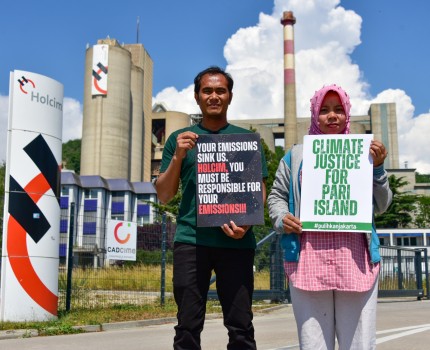
The Swiss company Holcim likes to present itself as a sustainable company: that it takes the challenges of climate change seriously and aims to achieve net-zero production by 2025. Big words for a “Carbon Major” and leading cement manufacturer. Yet such big words pale in size when compared to Holcim’s carbon footprint: Holcim is responsible for 0.42 percent of all historical global industrial CO2 emissions – with worldwide impacts.


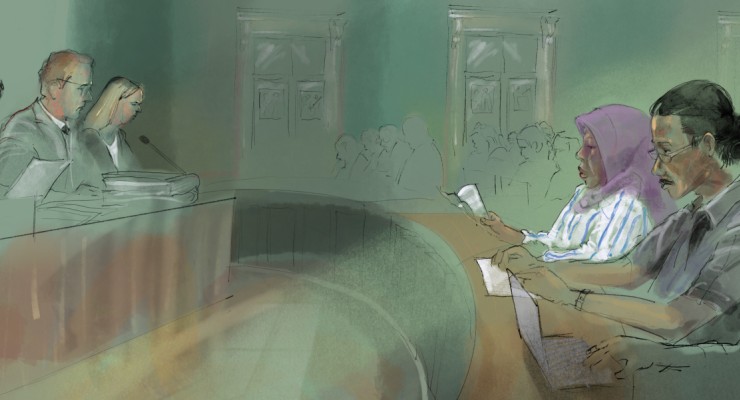
“I feel the effects of climate change every day. Where will we go when our island sinks?” asks Ibu Asmania on 3 September in Zug, Switzerland. Asmania and three other fishermen from the Indonesian island of Pari have sued Holcim. They are demanding the rapid reduction of Holcim’s CO2 emissions, as well as financial participation in flood protection measures and compensation for climate damages suffered, to protect their island from climate change. According to current estimates, Pari could be almost entirely flooded as early as 2050 – a disaster that can still be prevented.


Ibu Asmania und Arif Pujianto during the court proceedings. Courtroom Sketch © Erika Bardakci-Egli

In Zug, the court has yet to reach a decision whether to admit the lawsuit, but the stakes are high. It would add to a growing series of decisions by international and national courts that excessive emissions may indeed carry legal consequences. With the ICJ’s recent advisory opinion affirming that climate protection is a human right and, among others, a May 2025 German ruling establishing that, in principle, Carbon Majors can be held liable for climate risks – the current international consensus is becoming undeniably clear. Major greenhouse gas emitters must no longer shirk their responsibility.


More about the case


Read our Q&A

Following emissions back to the source: Edi Mulyono and Ibu Asmania in front of the Eclépens cement plant in the Swiss canton Waadt © Lorenz Kummer/HEKS

Taking polluters to court 

We fight for climate justice with those on the front lines of the crisis. Countries and companies with massive CO2 footprints must not only be forced to take responsibility for the effects of their emissions – they must reduce them now!

Donate now

BUSINESS AND HUMAN RIGHTS

Selling out supply chain safeguards

The German Supply Chain Act, which came into force on 1 January 2023, is a milestone despite its structural weaknesses: for the first time, German companies are held legally responsible for human rights and environmental risks along their global supply chains. Now, the German government has proposed amendments that officially aim to “reduce administrative burdens” and “increase ease of enforcement” – euphemisms for a calculated gutting of the law. These proposed changes would result in a “relief” of 4.1 million euros, a sum that corresponds to 0.001% of German GDP – statistically speaking, a rounding error. The price for these symbolic “savings”? Companies’ reporting obligations are to be abolished, while the number of offenses penalized with a fine would be reduced from 13 to 4 – as if it were enough to trust companies to comply voluntarily. If the German socialist party (SPD) does not intervene, the law's enforcement mechanisms would be furthered hollowed out, with the risk that it eventually becomes little more than a voluntary commitment – a model that has already proven to be a failure. 


Read our statement (only available in German)

Read our report “Two years of the German Supply Chain Act” (only available in German)

INTERNATIONAL CRIMES AND ACCOUNTABILITY

Alleged war crimes in Gaza: Criminal complaint against IDF soldier from Germany

On 10 September, ECCHR and partners filed a criminal complaint with the German Federal Public Prosecutor's Office against a member of the Israeli army from Munich. This individual is suspected of having been involved in the targeted killings of unarmed Palestinian civilians in Gaza. The organizations are calling for the initiation of international criminal investigations on suspicion of war crimes and crimes against humanity. Based on extensive evidence documented through investigative research and audiovisual recordings, the complaint points to the existence of a sniper unit within the IDF known as the “Ghost Unit,” the 9th platoon of the auxiliary company of the 202nd Paratrooper Battalion. Between November 2023 and March 2024, a series of targeted killings of civilians took place in and around Al-Quds and Nasser hospitals, with witness reports consistently confirming targeted sniper shootings. Numerous soldiers with dual citizenship have served within the identified unit, and legal action has already been taken against some of its members in France, Italy, South Africa and Belgium. ECCHR emphasizes that Germany has a fundamental obligation to investigate suspected perpetrators of core international crimes – especially when the accused are German-born or German nationals.


More about the case

The Pretense of Justice: Israel’s unwillingness to prosecute international crimes against Palestinians

When arrest warrants were issued by the International Criminal Court against Prime Minister Netanyahu and Defense Minister Gallant, Israel rejected these measures, claiming that its own judicial system was capable of independent prosecutions – a position supported by the German government. However, our new report, The Pretense of Justice, reveals a decades-long entrenched culture of impunity: even egregious violations such as war crimes or incitement to genocide remain unpunished when state actors are responsible. Equality before the law is, in practice, denied to Palestinians. Particularly in the context of the war in Gaza, with its massive civilian casualties and widespread destruction of civilian infrastructure, it is clear that national proceedings remain inadequate and systematically shield alleged perpetrators from accountability. Only through international criminal justice can this impunity be challenged and international law upheld.


Read the report

First arrest in Germany based on ICC warrant

The International Criminal Court (ICC) accuses Libyan citizen Khaled Mohamed Ali El Hishri of committing or ordering crimes against humanity and war crimes. As a guard at Mitiga prison in Tripoli, El Hishri is allegedly responsible for murder, torture, rape, and other forms of sexual violence, among other crimes. On the basis of an ICC arrest warrant, El Hishri was arrested at Berlin-Brandenburg Airport on 16 July by German authorities, who had to apply the legally regulated transfer and extradition procedure. The use of this procedure is a first in the country’s enforcement of international law and also carries significance beyond the individual case – especially in light of existing ICC arrest warrants against Netanyahu and Putin.


In the El Hishri case, the competent Higher Regional Court (OLG) of Brandenburg considered the formal requirements to be fulfilled for transfer to The Hague. Although the German law on cooperation with the ICC does not provide for any legal recourse against this decision, El Hishri has lodged an appeal with two central claims. First, Libya is not a member state of the ICC, and secondly, he is protected by diplomatic immunity. We consider neither of these arguments to be valid, and the OLG also dismissed El Hishri's appeal and referred it to the Federal Court of Justice for a decision.


Read the press statement

Watch the instagram-reel

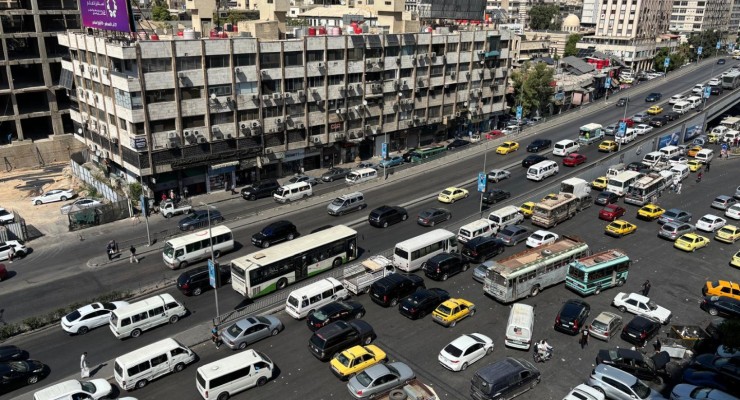
Road traffic in Damascus: The large number of cars, especially black SUVs where you cannot see who is inside, is striking. © Joumana Seif

Letter from Damascus #4

After 12 years in exile, human rights lawyer and ECCHR Senior Legal Advisor Joumana Seif was able to return to Syria for the first time. In her fourth letter from Damascus, she describes the growing frustration in civil society – caused by the everyday challenges of the last few summer months, such as extreme heat, power and water shortages, lack of infrastructure, and economic hardship, but also by the current political atmosphere. Violence and military solutions – especially in the Suweida region – continue to dominate, amidst a lack of dialogue and the deepening of social divisions. But Joumana Seif also points to new hope: the National Rescue Initiative, founded in July, aims to bring together people of different political, religious, and ethnic backgrounds, genders, and ages to develop shared visions for Syria's future through dialogue.


Read "Letter from Damascus #4"

Subscribe to our “Letter from Damascus”

ECCHR

Justice that stays: A legacy for the future

International Legacy Giving Day on 13 September invites us to reflect on what will remain after we are gone. Leaving behind a legacy is not only about possessions, but also about passing on values, dreams and a better future. Yet for many, inheritance and wills remain difficult, even taboo, topics that are new, unfamiliar and often unsettling. With our legacy brochure, we are attempting to break this taboo and address the issue.


Read our Legacy Brochure

EVENTS

Pesticides, profits and politics

The cultivation of genetically modified soy, the associated use of pesticides, and the resulting damage in South America are the subject of an OECD complaint against Bayer. It was filed in April 2024 by several organizations in Latin America with the support of Misereor and ECCHR. At this event in Geneva, German political responsibility concerning these impacts will be discussed, using this complaint as an example. This raises the fundamental question as to how states can address the structural causes of human rights violations inherent in the business model of the agricultural industry.


18.09.2025, 6:30 – 7:30 pm, Room S3, Maison de la Paix, Chemin Eugène-Rigot 2, Graduate Institute of International and Development Studies, Geneva


Online access

Brunch Talk with human rights lawyer Ben Wizner

At this Brunch Talk, Ben Wizner will join Wolfgang Kaleck to discuss current human rights challenges and recent legal battles. Since Donald Trump’s return to the White House in 2025, Wizner and the ACLU have filed 79 lawsuits against the administration, winning injunctions or favorable rulings in nearly three quarters of them. Wizner, who represented Edward Snowden and has long been at the forefront of defending civil liberties in the US, has helped shape key geopolitical developments through his work. 


21.09.2025, 12:00 pm, ECCHR, Zossener Str. 55-58 (Entrance D), Berlin


More info

Understanding Prison: MENA Prison Forum in Berlin #5 – Libya

The Berlin premiere of the documentary Escaping Libya’s Detention Industry will be followed by a discussion on international crimes committed against migrants and refugees in Libya and the Mediterranean. David Yambio (Refugees in Libya), Phoebe Walton (Forensis) and Allison West will address the role of European border-externalization deals – such as the Italy-Libya Memorandum of Understanding – in furthering these crimes, and the urgent need for European accountability and policy change.


06.10.2025, 7:00 pm, BuM, Paul-Lincke-Ufer 21, Berlin


More info and registration

On Justice #6: Gaza, international law, and the discourse of genocide

First-Person History in Times of Crisis is the subtitle of Omer Bartov's new book, which was published in German in April. Questions of genocide, the Holocaust and Israel-Palestine, which he explores here as a historian, are also themes in his personal history. A similar dual perspective, albeit from a different location, is taken by Ahmed Abofoul, a Palestinian international law expert from Gaza, who, in our current annual report, described the Nakba as a crime that has so far been ignored by international law. These perspectives will be brought together in a discussion as part of our “On Justice” event series, moderated by the historian Stefanie Schüler-Springorum and Chantal Meloni.

 
9.10.2025, 7:00 pm, Hebbel am Ufer 1, Stresemannstr. 29, Berlin

 
More info and tickets

Negotiating without those affected? Reconciliation without justice?

A discussion on the German-Namibian handling of colonial injustice. Speakers (to be confirmed) include Paul Thomas (NTLA), Almaz Teffera (HRW) and others. Organized by ECCHR, GfbV, WÖK, Decolonize Berlin & Attac. 


Save the date: 10 October 2025 at 5:00 pm at ECCHR & Livestream.

More info & registration coming soon on our website

Law against war

Leipzig's St. Nicholas Church, a symbol of the Peaceful Revolution of 1989, remains a place of remembrance against war and violence to this day. During the traditional peace prayer, Wolfgang Kaleck, among others, will speak about the importance of international law and universal human rights as protection for the weak, minorities, and civil societies. As part of the peace prayer, the Leipzig Appeal will be formally presented, which clearly opposes war and the erosion of international law. Visitors will have the opportunity to sign the appeal on location.


13.10.2025, 5:00 pm, Nikolaikirche Leipzig

2025 Justice for Syria: Recital & Symposium

“The world's leading figures in the search for justice and reconciliation for Syria” – this is how Oxford University announces an extraordinary event, where Joumana Seif and Patrick Kroker will join former US Special Representative for War Crimes Stephen Rapp, among others, in a discussion. Musician Wassim Mukad – a prisoner of the Assad dictatorship and medic during the civil war, who is now a witness in several court cases – will open the evening with a solo oud recital.


13.10.2025, 7:00 pm, St Hilda's College, Cowley Place, OX4 1DY Oxford


More info and registration

Together for global justice!

Justice requires perseverance and people who stand firmly by our side. Become a supporting member and help strengthen our efforts for a more just future. Only in this way can we continue to critically examine government actions and defend the rights of those affected worldwide.

Becoming a member now!

PAST EVENTS

Law and revolution: Prefiguration or abolition?

This conference at the European University Institute in Florence explored the theoretical and practical challenges of law’s place in revolutionary politics. Nerges Azizi presented an analysis on the role of requesting interim measures at the European Court of Human Rights to prevent pushbacks.


More info

Follow the profit

Silvia Rojas Castro explored corporate accountability options to tackle the involvement of European companies profiting from the pushbacks and detention in the Aegean at a workshop on “Economies of Expulsion: Mapping Pushbacks and Detention in the Aegean Region” on 8 – 10 September. It was hosted by the Feminist Autonomous Centre for Research and Legal Centre Lesvos.

PUBLICATIONS

The Gaza family torn apart by IDF snipers from Chicago and Munich (only available in German)

The Guardian, 10 September 2025


How the Spiegel tracked down a suspected war criminal (only available in German)

Der Spiegel, 10 September 2025


Sinking homeland (only available in German)

Frankfurter Allgemeine Zeitung, 6 September 2025


Tiny island against cement giant (only available in German) 

taz, 3 September 2025


Izza Drury

S.S. and Others v. Italy: The Danger of All or Nothing Framing

OpinioJouris, 19 August 2025


Wolfgang Kaleck
Interview: Experts – "German government divides Europe" (only available in German)
t-online, 10 August 2025


Belgium’s Arrest of IDF Soldiers Could Be a Watershed Moment

Jacobin, 4 August 2025


Reckoning with the genocide of the Yazidis: In the ground and in the courtrooms (only available in German)

taz, 3 August 2025


Could the EU be held criminally liable in the Mediterranean? Flying at the borders of the law (only available in German)

Tagesspiegel, 30 July 2025


Patrick Kroker

Interview: What the verdict against Alaa M. means (only available in German)

Dis:Orient, 28 July 2025


Arne Bardelle
A Historic Chance Missed: Harmonization of the ICC’s Jurisdiction over the Crime of Aggression Delayed Once More

OpinioJuris, 25 July 2025

RADIO / PODCAST / VIDEO

Alexander Schwarz

Suspicion of war crimes – Did a Munich resident kill civilians in Gaza? (starting from min. 28:38) (only available in German)

ZDF frontal, 9 September 2025


Silvia Rojas Castro

Death in the desert: How responsible is EU refugee policy? (only available in German)
ARD Audiothek, 28 August 2025


Wolfgang Kaleck

The Strength of Law or the Law of the Strong? The Future of International Law (only available in German)
Böll Fokus, 24 July 2025

SECURING THE FUTURE OF HUMAN RIGHTS WORK

We are training the next generation of human rights defenders to strengthen our global commitment to a more just future. In times of increasing repression, global crises and growing inequality, we need courageous voices – and the financial support that makes their work possible.

Donate now

Let's stay in touch!

+49 (0)30 69506023          newsletter@ecchr.eu

ECCHR

EUROPEAN CENTER FOR CONSTITUTIONAL AND HUMAN RIGHTS
Zossener Straße 55 – 58
D – 10961 Berlin

+ 49 30 400 485 90
info@ecchr.eu

If you no longer wish to receive this email, you can unsubscribe here. 

bluesky facebook instagram linkedin youtube

Bank details
Name: ECCHR
Bank: Berliner Volksbank
IBAN: DE77 100 90000 885360 7011
BIC: BEVODEBB

Further information on data protection and imprint.