Open in Browser

GROUNDBREAKING: THE LUMUMBA TRIAL, THE LAFARGE CONVICTIONS AND DEFENDING INTERNATIONAL LAW

APRIL 2024 | NEWSLETTER 110

Recent weeks have seen major progress in breaking the shield of impunity for corporate crimes and colonial violence. The verdict in the Lafarge case, after nearly a decade of legal work, set an important precedent for corporate accountability: executives and the company itself were found guilty of financing terrorism and violating sanctions by paying armed groups in Syria to keep a cement plant running, amidst the civil war. The trial showed how corporate structures can enable criminal conduct through diffused responsibility. In the Lumumba case, a Belgian court has decided to move forward with a trial addressing Belgium’s role in the assassination of Congo’s first Prime Minister. Together, these cases highlight new avenues for addressing impunity within complex bureaucratic systems that obscure accountability. Learn more about these cases and others in this newsletter.


The ECCHR Team

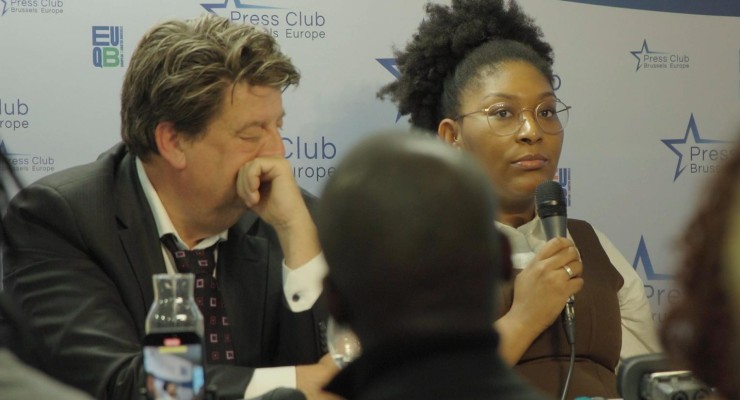
Yema Lumumba and Wolfgang Kaleck at a press conference in Brussels on the criminal proceedings that have now been opened against one of the alleged murderers of her grandfather. Patrice Emery Lumumba. © ECCHR

Trial on Assassination of Patrice Lumumba: Addressing Belgium’s role

A trial for murder, starting roughly 65 years after this war crime was committed – indeed, you might wonder about the significance of such a reckoning with colonial violence after so many years. For survivors and their descendants, the reason is clear: the crimes committed remain open wounds that need to heal. As Belgium’s role in these crimes was never properly acknowledged or documented, this also undermines the veracity of the historical record. This is why the decision by a Belgian court to open a criminal trial goes far beyond justice for the Lumumba family. The trial thus represents a milestone development in reckoning with European colonial violence that still shapes present realities, affecting a large number of people. ECCHR has supported the case since 2011, and in summer 2025, Wolfgang Kaleck was officially appointed as legal counsel for the family.


The 1961 assassination of Congo independence leader Patrice Lumumba had lasting consequences for the Democratic Republic of Congo. Had he lived, the country might have followed a very different path, less defined by extractive exploitation of its mineral wealth – a system that enriched Western actors while impoverishing the population and enabling severe human rights abuses. Lumumba’s murder served to protect these interests, as Belgium, even after its brutal colonial rule, retained significant economic stakes in Congo that his policies had threatened. 


A Belgian court will now examine this history in a trial against Étienne Davignon, a high-ranking Belgian politician and diplomat (now 93), who allegedly played a role in Lumumba’s capture and killing. The proceedings aim to clarify his responsibility, establish historical truth, and deliver long-overdue justice. While Davignon was not the only actor, the trial may expose the broader, systemic nature of colonial violence – where responsibility is often bureaucratically diffused across networks of power, creating accountability gaps. In the words of the Lumumba family: "For our family, this is not the end of a long fight, it is the beginning of a reckoning that history has long demanded. For Congo, for Africa, and for all former colonies, we believe this moment carries meaning beyond our name."


More about the case

BUSINESS AND HUMAN RIGHTS

Lafarge verdict: Landmark ruling for corporate accountability 

“This decision condemns cynicism in the business world. The cynicism that places profit above all else – above human life, above accountability. The cynicism of pretending that you can build business relationships with armed groups like the Islamic State while they were perpetrating crimes against humanity and genocide and pretend that you didn't understand the consequences of your actions." 


What Claire Tixeire said on 13 April, immediately after the verdict against French multinational Lafarge for financing terrorism through its Syrian subsidiary, sums up why we consider it a major victory in the fight against impunity for multinationals involved in serious human rights violations that sets a legal precedent. French parent companies can no longer hide behind their foreign subsidiaries to evade responsibility. For the first time, a French company has been convicted of financing a terrorist organization. As Cannelle Lavite said, “what the court clearly condemned is an opaque payment system organized by the joint decisions of senior executives of the Paris headquarters and the Syrian subsidiary, with the unique aim of protecting Lafarge’s profits and competitiveness in a war-torn region. Thus, while the former top executives of Lafarge – including the former CEO – were found guilty, the multinational itself could not evade responsibility.”


First and foremost, this victory belongs to the former Syrian employees of Lafarge who joined the case as civil parties. A dozen of them joined the trial where they recounted their daily lives marked by the threat of dismissal, kidnappings, crossing areas under sniper fire and through checkpoints, bombings, and under the constant risk of reprisals from armed groups. Even though the court said they testified with “strength, precision, dignity and humanity,” it ruled that they were not entitled to compensation, finding that individuals cannot qualify as victims of terrorism financing. More than a decade after the events, the former Syrian employees will thus leave the courtroom empty-handed, forced to wait even longer for justice to be served. And we will continue to support their fight for reparations.  

  
Read and watch more on the verdict

Donations against impunity

In a landmark ruling this April, several executives from the French cement company Lafarge were held accountable. Financial support from people like you enables us to take long-term action against corporate human rights abuses, now and in the future.

Become a member!

Organized Opacity

“Arms export decisions are not above the law,” says Cannelle Lavite – even though French court decisions over the last five years give the opposite impression. Together with the government, the courts refused to grant ECCHR access to customs documents on arms exports to Saudi Arabia, the UAE and Egypt. Their justification: that these documents cannot be disclosed, as they are protected by national defense secrets and France's foreign policy conduct. Given that these arms may have been used to violate International Humanitarian Law during the Yemen conflict, we consider this information essential to enable public debate. Together with investigative media Disclose and Amnesty International France, we have now filed a case before the European Court of Human Rights on the basis of Article 10 of the Convention: the right to freedom of expression and information. In the words of Cannelle Lavite: ”It is time to put an end to this institutionalized lack of transparency.”


More about the case and Corporate Accountability in the Arms Sector


Successful challenge to obstruction of the Supply Chain Act

The German Federal Ministry for Economic Affairs and Energy (BMWE) has reminded the Federal Office for Economic Affairs and Export Control (BAFA), which falls under its supervision, of its legal obligations regarding the implementation of the Supply Chain Act (LkSG). This outcome of a successful supervisory complaint is noteworthy for several reasons: first, the Ministry is currently best known for weakening the impact of this law – and, in doing so, sometimes preempting the parliamentary decision-making process through corresponding directives. Second, the Ministry has now actually recommended that the agency “consider the possibility (...) of transmitting files to parties to the proceedings electronically” or “allow the use of on-site photocopiers during on-site file inspections,” as well as take measures “to avoid redactions.” 


The reason for this official reprimand – which sounds like a bad joke – was the ongoing ordeal faced by our Ecuadorian trade union partner ASTAC since the fall of 2023. The farmworkers and farmers organized there had filed a complaint against the German supermarket chains REWE and Edeka under the LkSG. When, three months later, they had still heard nothing from the authorities regarding the next steps, ASTAC requested access to the case files. While this was granted in principle in October 2024, the complainants and their representatives – Franziska Humbert from Oxfam and Lisa Pitz – were not actually able to view the files until July 2025: with numerous redacted passages and with files held exclusively on-site at the agency’s headquarters in Borna, Saxony, where BAFA staff even refused to allow the use of the photocopier. REWE, on the other hand, had received the files not only more than three months earlier but apparently also electronically.


All of this prompted ASTAC, with the support of Oxfam, Misereor and ECCHR, to file a supervisory complaint with the ministry last September. According to Lisa Pitz, the fact that this led to the aforementioned request to BAFA at the end of March to comply with its legal obligations is a “success that really shouldn’t have been necessary.” After all, it should go without saying that a regulatory authority treats complainants as equals and instead focuses on supervising companies. Otherwise, the law cannot possibly be effective.  


More about the case and the successful complaint to the authorities

INTERNATIONAL CRIMES AND ACCOUNTABILITY

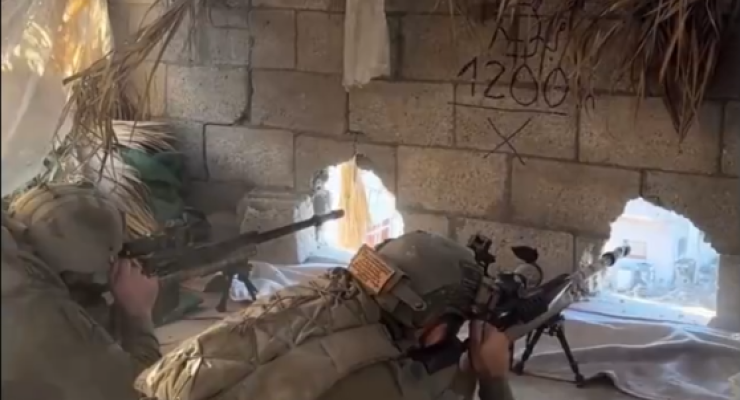
Members of the IDF “Ghost Unit” on a rooftop in Khan Younis in February 2024. The unit’s logo is visible on the wall, alongside the words “1200 m | X,” indicating a sniper hit from a distance of 1,200 meters. Credit: Screenshot from a documentary, posted on X by Younis Tirawi (@ytirawi)

Gaza Sniper: 7 Months later – The Federal Prosecutor’s Office is still “monitoring” the case

Our criminal complaint has been with the Federal Prosecutor’s Office since September 2025: a person from Germany is alleged to have deliberately killed Palestinian civilians in Gaza as a member of the so-called “Ghost Unit,” a sniper unit of the Israeli army. The response? The authorities are “monitoring” the case. For seven months now.


That is why we are now submitting new evidence and once again demanding a person-specific investigation, as well as a structural investigation into further crimes in Gaza.


Even in the case of the German-Palestinian Kilani family, who were killed in an Israeli airstrike in 2014, Germany “pre-investigated” the matter for seven years – without results. Leaks show that Israel actively worked to ensure that Germany would drop the investigation.


Israel itself does not conduct serious investigations or prosecutions to effectively pursue international crimes against Palestinians, as documented in our report “The Pretense of Justice.” Germany therefore has a duty to exercise its jurisdiction under the principle of universal jurisdiction to prevent impunity.


More about the case

Your commitment to justice

For decades, international crimes against Palestinians have systematically gone unpunished. Your donation helps us to stay the course and keep up the pressure – so that impunity for war crimes committed by the Israeli army does not prevail.


Donate now

Crime of Starvation – From Yarmouk to Gaza

A refugee camp that once was a vibrant Palestinian district and integral part of Damascus, Yarmouk became a site of extreme state violence in the aftermath of the 2011 revolution. Following mass protests in 2012, the Assad regime and its allied militias imposed a brutal siege. Civilians were cut off from food, medicine and aid. “Besiege, starve, force to surrender” became the strategy of the regime. Since November, these crimes are being examined in court in Koblenz, Germany for the first time. 


The experiences from Yarmouk reveal alarming parallels to Gaza – with the deliberate destruction of humanitarian aid structures, the cutting-off of supply routes, and the starving of civilians. In light of the ongoing court proceedings in Koblenz, the question arises: After war crimes involving the deliberate use of hunger as a weapon, are there opportunities for justice and accountability, from Yarmouk to Gaza?  

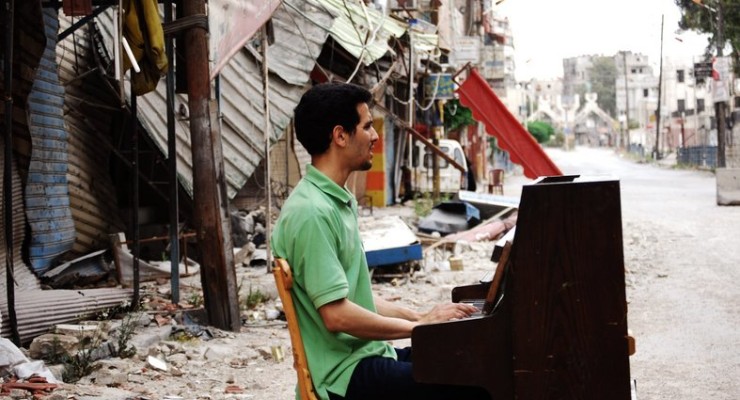
 Pianist Aeham Ahmad during the siege in Yarmuk © Lamis al-Kathib

These questions are addressed in the seventh edition of the series “Understanding Prison: MENA Prison Forum in Berlin”: Pianist Aeham Ahmad, who survived the starvation siege of Yarmouk, will perform together with activist Wassim Mukdad on Oud. The actress Lujain Mustafa will read from Aeham Ahmad’s book, followed by a panel discussion. 


Tickets and more information on program and participants

Iran: Military aggression is no substitute for investigations

To break the cycle of violence against its own population and ongoing impunity in Iran, ECCHR called on the Federal Prosecutor’s Office in February to initiate structural investigations and, where appropriate, person-specific investigations into alleged international crimes.


Just a few days later, the US and Israel launched airstrikes against Iran. Contrary to the demand we and numerous representatives of the Iranian diaspora had made days earlier – to choose legal pressure over military aggression – the German government failed to issue a clear statement condemning the attack, which violated international law. By granting the US access to the Ramstein Air Base during the war against Iran and providing logistical support for the military conduct on German territory, the German government is contributing in a devastating way to the erosion of international law from within. 


Alexander Schwarz also addressed this alarming development before the Foreign Affairs Committee of the German Parliament, reminding its members of Germany’s historically rooted commitment to international law. He further debunked the claim – frequently made today – that there is a contradiction between international law and the protection of human rights. Rather, the prohibition of the use of force is “not only a fundamental norm of international law, but also a central instrument for the protection of human rights.” His conclusion for the foreign policy experts gathered in the committee is: “When we consider all of this together – the Basic Law’s commitment to international law, the prohibition on supporting wars of aggression that violate international law, the jurisprudence of international courts, and the principles of international criminal justice – a clear common thread emerges: The Federal Government is increasingly coming into conflict with the legal foundations upon which the Federal Republic was established.”


Read an analysis by Arne Bardelle and Alexander Schwarz and our letter to the Federal Public Prosecutor

ECCHR recommendations for Crimes against Humanity Convention negotiations 

Crimes against humanity – such as murder and torture committed as part of widespread or systematic attacks on civilians – are among the four core crimes under international law, yet no binding treaty addresses their prevention and punishment. In 2025, the UN General Assembly began a process to adopt a convention by 2029 based on the International Law Commission’s 2019 Draft Articles. While this signals progress, targeted amendments are needed to ensure comprehensive protection, while preserving existing standards. ECCHR therefore issued policy recommendations urging States to strengthen the draft treaty, including expanding gender justice provisions, recognizing gender apartheid, and adding crimes such as forced marriage and reproductive violence. Further proposals include lowering thresholds for enforced disappearance and explicitly criminalizing starvation and the slave trade. The recommendations also support strong provisions on universal jurisdiction and corporate liability, stricter limits on amnesties, improved victim rights protections, and a dedicated monitoring and complaints mechanism.


Read our recommendations

CICC Report on Sanctions

How do US sanctions against international justice actors affect efforts to ensure accountability? The report “Criminalising Accountability: The U.S. Lawfare Against the International Justice System” by the Coalition for the ICC (CICC) examines the complex architecture of the US sanctions regime and shows how these measures are being used in ways that undermine international justice efforts at the International Criminal Court and by civil society actors. A climate of chilling effects and overcompliance further amplifies the reach of the sanctions regime. Ultimately, the price is borne by victims and survivors of international crimes, as well as by those who continue their work under increasing pressure. “NGOs should resist these measures and take a principled view as much as they can. Private donors and NGOs should also remain principled vis à vis the Palestinian organizations, continue to support them and not shy away: such pushbacks need to be met with resistance,” says Andreas Schüller.


Read the press release

Knowledge exchange in Kampala to address international crimes in Sudan

In April, ECCHR held two strategic exchange workshops in Kampala, Uganda, with five Sudanese human rights organizations. The workshops, organized and facilitated by Nerges Azizi and Arne Bardelle, explored the potential of universal jurisdiction and strategic litigation to advance accountability for crimes committed in Sudan. In the context of the Global Initiative against Impunity, the workshop is part of a ten-month-long knowledge exchange program, consisting of regular meetings and workshops with partner organizations and aimed at supporting civil society organizations with leading justice and accountability efforts, including case building, documentation and litigation. In previous years, ECCHR has supported organizations from Afghanistan and Palestine as part of this program.


For more information on universal jurisdiction in practice, please consult our videos 

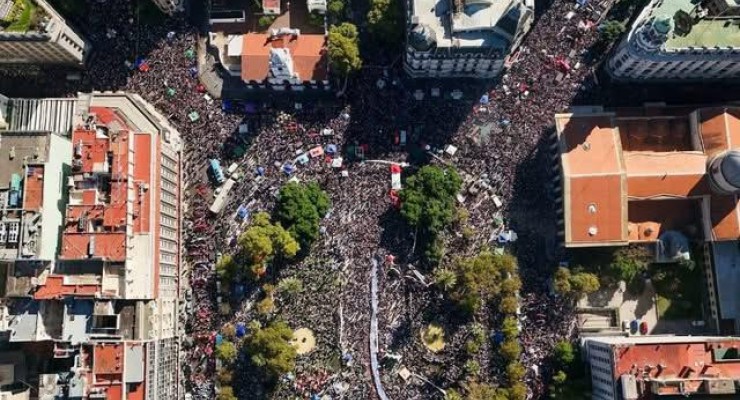
Demonstration in Buenos Aires on 24 March 2026 © ECCHR

Argentina’s Dictatorship Crimes and Germany’s Role

On the occasion of the 50th anniversary of the military coup in Argentina, a million people took to the streets in the capital, Buenos Aires. One of them was Wolfgang Kaleck, who has been involved since 1999 in the criminal prosecution of crimes committed by the Argentine military dictatorship. To date, he has represented over 50 survivors of torture and their family members in criminal proceedings in Germany and has observed trials in Argentina, where he also served in an advisory capacity. Wolfgang Kaleck continues to represent the trade unionist and torture survivor Hector Ratto, a former employee of Mercedes-Benz in Argentina. Based on his testimony, criminal proceedings have been underway in Germany since 1999. Another case is currently pending before the Federal Court in San Martin in the province of Buenos Aires. Wolfgang Kaleck has been named as an expert witness there and will testify at the trial. During his visit, he also participated in a vigil organized by Argentine human rights organizations and served as a guest speaker at the presentation of a report and the opening of an exhibition on the crimes of the dictatorship.


Watch the recording of the joint commemorative event in Berlin and read our Argentina dossier in the Living Open Archive

ECCHR

Rights without Guarantee: ECCHR 2025 Annual Report launch

On 18 May, ECCHR will launch the publication of its 2025 Annual report, reviewing our work over the last year, along with the growing legal and geopolitical challenges that human rights work faces at the current moment. The report features articles by Eva von Redeker, Mark B. Taylor, Charlotte Wiedemann and ECCHR staff, among others. In addition to an exhibition by the artist Ahmed Isamaldin, whose artwork is featured in our annual report, he will join Wolfgang Kaleck, Miriam Saage-Maaß, Sinthujan Varatharajah and other ECCHR staff for a discussion on war economies and strategies of resistance at the ECCHR office in Berlin on 18 May at 6:00 pm. If you would like to receive a copy of the Annual Report in print, please send an email to presse@ecchr.eu and one will be sent to your address.


More info and registration

Spotlight on international law: ECCHR at re:publica

We are delighted to be taking part in three events at re:publica this year! Wolfgang Kaleck will kick things off on a panel with Prof. Kai Ambos and Sham Jaff as part of the WDR Europaforum. In light of repeated, flagrant and blatant breaches of international law, primarily by the US, Europe’s stance towards its NATO partner is being called into question with increasing frequency. If international law goes down the drain – what role should Europe play?


The landmark conviction of Lafarge is the first judgement against a company for terrorist financing and breaches of international sanctions. Yet the fact that companies prioritize their profits over human rights and international law is by no means an isolated case. Claire Tixeire and Canelle Lavite will report from their years of experience with the Lafarge precedent and a criminal complaint against Total Energies, to discuss how the law can be used to hold companies accountable.


Our third panellist, Alexander Schwarz, discusses the significance of digital evidence with Frederik Obermeier. The numerous online videos depicting the suffering and destruction in Gaza have made it possible to draw the world’s attention to the injustices – but not only that. Mobile phone videos, social media and satellite images equally serve as documentation of potential war crimes. In the fight against impunity for international crimes, they are a powerful tool.


18 –20 May 2026, re:publica, STATION Berlin, Luckenwalder Straße 4-6, 10963 Berlin


Book launch: The strength of law vs the law of the strongest

As the geopolitical situation has changed dramatically in recent years, international law has come under pressure. A multipolar world is emerging, with a more powerful Asia, led by China, and an increasingly fragmented West, raising questions about the future role of international law. Yet for many, the world has never been in order, and recent decades have been marked by repeated violations of the rules-based international system, including wars and crimes against humanity. Russia’s attack on Ukraine, Israel’s actions in Gaza, the West Bank and Iran, and US intervention in Venezuela all show growing disregard for international law and human rights. At this turning point, the key question is whether international law can withstand these pressures or whether power politics will prevail. Wolfgang Kaleck explored human rights, the international legal order, and new alliances for a more just future in a discussion of his book with Andrian Kreye, Luisa Neubauer, Mithu M. Sanyal, moderated by Pauline Jäckels.


Read the book (English version forthcoming)


Additional book presentations in June in Frankfurt, Wiesbaden, and Bonn. More information soon on our social media channels

bluesky facebook instagram linkedin

© ECCHR

A motivating marathon

Thank you for your outstanding commitment to this year’s Berlin half marathon and for your generous support of ECCHR. We look forward to joining you again next year and building on this momentum to achieve an even greater impact.

BORDER JUSTICE

ICE-style deportations and offshore detention coming to the EU

EU institutions are now finalizing a law that would normalize harmful mass deportations. The deportation (aka return) regulation would extend the detention of people on the move – including families with children and unaccompanied minors – for two years or longer. It would facilitate deportation to offshore prisons via “return hubs.” It would expand police powers to raid private homes. Alarmingly, a coalition of MEPs has already teamed up with the far-right to push the regulation through parliament, paving the way for negotiations on finalizing the text. Spain is one of the few member states raising concerns, along with France. Germany’s Friedrich Merz has said he won’t cooperate with the AfD, although his track record tells the opposite. ECCHR joined the “Wekeepussafe” campaign (which hosts a petition and template to email MEPs) to help put pressure on MEPs and national governments to re-think this incredibly harmful and wasteful policy.

Resisting violent border infrastructures

The increasing militarization and invisibilization of borders through tech-driven surveillance was the topic of a conference hosted by the Border Violence Monitoring Network on 16 –17 March. Borders are being used as a site to test out new tech which enables racial profiling, incarceration and fast pushbacks of people on the move and which makes on-site support or documentation more and more difficult. Silvia Rojas-Castro presented a map of legal tools and explored avenues to legal accountability.

Undoing the Coloniality of Mobility Regimes, Narratives and Laws

At the intersection of law and narratives, Hanaa Hakiki convened a conference panel at NOVA University of Lisbon (16 April) interrogating the role of narratives in law-making along with Professor Aghogho Akpome (University of Zululand). Together they looked at how far narratives – rather than legal reasoning – informed the logic behind the ND and NT judgment, a case brought by two Black African men against Spain for their pushback from Melilla and supported by ECCHR. Instead of championing individuals’ rights, the European Court of Human Rights refused to condemn the pushbacks and constructed a new legal doctrine blaming the applicants and relying on blatantly racist and colonial narratives in their reasoning. 

INSTITUTE FOR LEGAL INTERVENTION

ECCHR international summer school on climate justice and corporate responsibility

From 4 – 9 October 2026, the European Center for Constitutional and Human Rights (ECCHR), Friedrich-Alexander University Erlangen-Nuremberg (FAU), and Tilburg Law School will host an international summer school in Nuremberg on corporate responsibility and climate justice. The program ranges from work on specific case studies to panel discussions on major topics in legal philosophy and legal policy, and provides an impressive overview of the current state of legal interventions in these fields. Among the experts contributing to the curriculum are Jameela Joy Reyes (LSE), Phillip Paiement (Tilburg Law School), Daniel Augenstein (Tilburg Law School & ECCHR), Markus Krajewski (FAU), and Miriam Saage-Maaβ (ECCHR), as well as other specialists in the fields of business and human rights and climate justice.


More about the summer school

From genocide to green hydrogen: the Hyphen project in Namibia

How are German colonial genocide, territorial dispossession of the Nama people and current renewable energy projects in Namibia connected? A recently published analysis by Anne Schröter and Andrea Pietrafesa examines how unresolved reparations for colonial genocide and land expropriation and the right to self-determination are resurfacing today in the context of the energy transition. The planned green hydrogen project “Hyphen” shows that, without historical justice and territorial rights, energy transition policies reproduce colonial practices and narratives while justifying capitalist expansion and exploitation as green colonialism. A truly just energy transition must address structural inequalities inherited from colonialism and recognize indigenous communities as rights-holders. Ultimately, the situation faced by the Nama people reminds us that decisions about energy and ecosystems are not just technical or economic, but that they reflect the ways that societies confront their past and determine who has the right to make decisions about the future.


Read the analysis

FOR GLOBAL JUSTICE

The world can only be just when human rights are universally recognized and guaranteed for everyone. This is what we are fighting for across the globe:
with those affected, with partners, with legal means.
Thank you for helping us in our efforts to make this happen.

Donate now

EVENTS

International Criminal Law 1945 / 2026:

Between Norm, Politics, and Practice

“Postwar European Order” – in the midst of today’s chaotic and war-torn world, that might almost sound reassuring. In reality, however, this order was also a rather questionable one for the vast majority of humanity. For the international law developed since 1945 and the associated international judiciary were, from the very beginning, in tension with political power structures and military practices. Historian Annette Weinke and political scientist Mathias Deloi discuss with Alexander Schwarz the consequences this has had over the past 80 years and what lessons can be drawn from it for current and future challenges in international law.


04.05.2026, 6:00 – 8:00 pm, Centre Marc Bloch, Friedrichstrasse 191, 10117 Berlin


More about the event (only available in German)

Overshadowed:

The Escalation of Settler Attacks and Israel’s West Bank Annexation during the Iran Crisis – An event with Palestinian human rights lawyer Dalia Qumsieh 

While Israeli settler violence displaced more Palestinians in the first three months of 2026 than in all of 2025, it barely made international headlines. As global attention has shifted toward Iran since the US-Israeli attacks, escalations in the Occupied Palestinian Territory, particularly in the West Bank, largely remain outside of international focus. Yet, Palestinians face an unprecedented surge of settler attacks, night raids, land grabs, displacement and political measures that further entrench Israel’s illegal occupation and annexation of Palestinian territory. In this discussion, Dalia Qumsieh, LL.M., Palestinian human rights lawyer and director of the Balasan Initiative for Human Rights based in Palestine, will draw on her work on the ground, providing first-hand insights and legal analysis of recent developments in the West Bank and the Occupied Palestinian Territory as a whole.


04.05.2026, 7:30 pm, ECCHR office, Zossener Str. 55-58 (Aufgang D), Berlin


More info and registration

Europe’s Deadly Borders on Trial

At the invitation of Watch the Med Alarmphone and Amnesty International, David Yambio (Refugees in Libya) and Miriam Saage-Maaß will discuss the possibilities for effective legal action against crimes committed at the EU’s external borders. The occasion is our joint communication filed with the International Criminal Court (ICC) regarding crimes against humanity committed against people on the move in Libya and in the Mediterranean, which were and continue to be committed in support of Europe’s efforts to seal itself off from migration.


31 May, 7:30 pm  Schauspielhaus Zürich Pfauen, Rämistrasse 34, 8001 Zürich


More information and tickets

PUBLICATIONS

Claire Tixeire

A Stunning New Verdict Rewrites the Rules of Corporate Morality

The New York Times, 17 April 2026


Canelle Lavite

Tough verdict against cement group Lafarge

Justiceinfo.net, 14 April 2026


Anne Schröter, Andrea Pietrafesa

From Genocide to Hydrogen: Historical Justice and Energy Transition in Ancestral Nama Terriories

Rosa-Luxemburg-Stiftung, 13 April 2026


Wolfgang Kaleck

Belgium: Murder of Lumumba will finally be brought to trial (Only available in German)

nd Journalismus von links, April 2026


Chantal Meloni

What would the world look like without international law? (Only available in German)

Rosa-Luxemburg-Stiftung, 31 März 2026


Wolfgang Kaleck

“The ending has yet to be written” (Only available in German)

Der Spiegel, 29 March 2026


Miriam Saage-Maaß

Why Pakistani farmers are suing two German companies for deadly 2022 floods

Al Jazeera, 20 März 2026


Valentina Azarova, León Castellanos-Jankiewicz, Tomas Hamilton, Canelle Lavite, Chloé Bailey

Corporate Accountability in the Arms Sector: Possibilities, Limits, and Visions of Justice

Cambridge University Press, 18 März 2026


ECCHR, Civitas Maxima, CJA, FIDH, REDRESS 

Universal Jurisdiction Annual Review 2026

TRIAL International, 2026


Wolfgang Kaleck

International law contested: “Cynicism ist not a viable political stance” (Only available in German)

Die Wochenzeitung, 12 March 2026


Wolfgang Kaleck

What if Trump decided to launch an attack on Greenland in the near future? (Only available in German)

Süddeutsche Zeitung, 9 March 2026


Andreas Schüller

Iran war: How Vulnerable Is Germany Because of the US Air Base in Ramstein? (Only available in German)

Berliner Zeitung, 7 March 2026


RADIO/TV/PODCAST

Wolfgang Kaleck

A Brief History of International Criminal Law – Deterrence Against Atrocities (Only available in German)

BR Radiowissen, 16 April 2026


Wolfgang Kaleck

Wolfgang Kaleck's passionate plea for international law (Only available in German)

ARD, titel, thesen, temperamente, 12 April 2026


Wolfgang Kaleck

Has international law failed, Wolfgang Kaleck? (Only available in German)

Rosa-Luxemburg-Stiftung, 2 April 2026


Wolfgang Kaleck

Who killed Patrice Lumumba? (Only available in German)

Deutschlandfunk Kultur, 1 April 2026

Let's stay in touch!

+49 (0)30 69506023          newsletter@ecchr.eu

ECCHR

EUROPEAN CENTER FOR CONSTITUTIONAL AND HUMAN RIGHTS
Zossener Straße 55 – 58
D – 10961 Berlin

+ 49 30 400 485 90
info@ecchr.eu

If you no longer wish to receive this email, you can unsubscribe here. 

bluesky facebook instagram linkedin youtube

Bank details
Name: ECCHR
Bank: Berliner Volksbank
IBAN: DE77 100 90000 885360 7011
BIC: BEVODEBB

Further information on data protection and imprint.