In her new 'Letter from Damascus', human rights lawyer and ECCHR Senior Legal Advisor Joumana Seif sheds light on the political, economic and social developments.
Open Browser

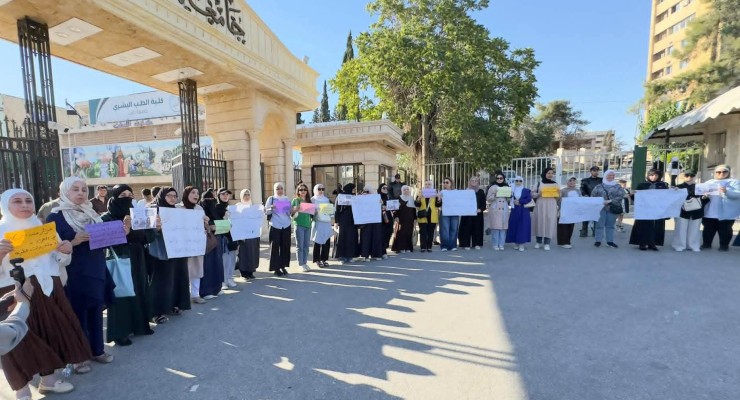
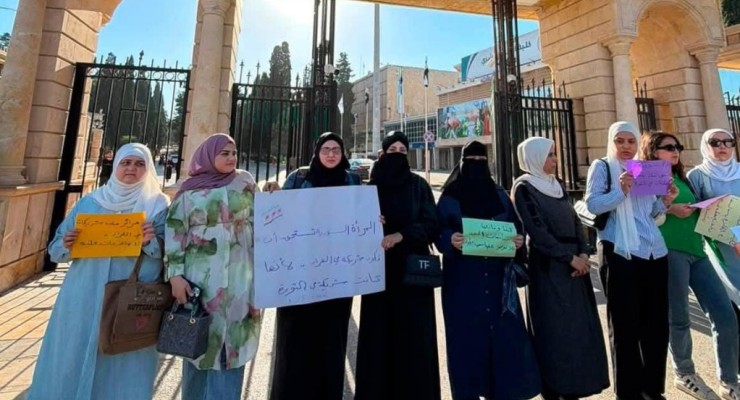
In the beginning of July, women organized a protest in Aleppo to express their opposition to women being excluded from appointments to the People's Assembly. © Joumana Seif

Letter from Damascus 

JULY 2026 | LETTER No. 8

Dear readers,


two weeks ago the "People's Assembly" held its first session. But how democratic can such an institution be, given the centralized authority within Syria's new political system and the intransparent selection process? And which people does the Peoples Assembly represent? Meanwhile, the economic situation in Syria is deteriorating. Rising energy, food and fuel costs are placing a heavy burden on post-war society, while social inequalities are increasing. In her new 'Letter from Damascus', human rights lawyer and ECCHR Senior Legal Advisor Joumana Seif sheds light on the political, economic and social developments.


Would you like to receive the ‘Letter from Damascus’ regularly? Register here!


The ECCHR Team

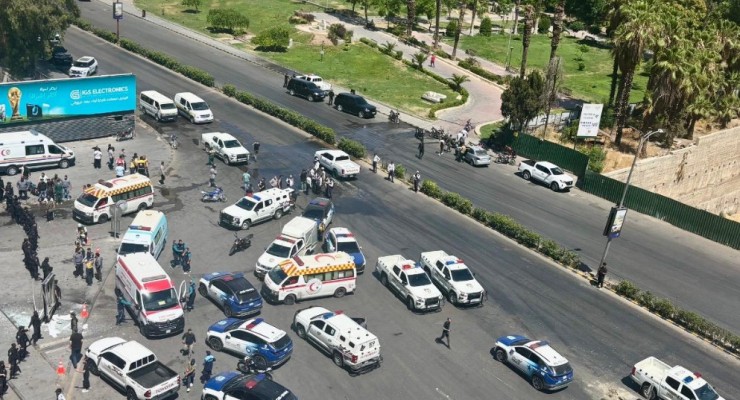
The center of Damascus after a bombing attack on 7 July - photographed by Joumana Seif from the windows of her human rights office © Joumana Seif

Written in Damascus in July 2026

Dear readers, 


The attack that took place on 2 July at a café near the Palace of Justice in Damascus claimed the lives of nine people and injured 28 others, most of whom were lawyers. A few days later, on 7 July, two successive explosions, occurred during the state visit of French President Emmanuel Macron to Damascus. The blast took place less than 30 meters from our office, only minutes after my colleague and I had passed through the same location. The explosion left us and our neighbours deeply shaken and fearful. I am not exaggerating when I say that my senses remain on constant alert. My heart still races whenever I pass through that same place every day.


Incidents as these highlight a broader reality: since the fall of the Assad regime, the new Syrian authorities have achieved notable and rapid progress in the field of foreign policy. However, these achievements have yet been to translate into tangible improvements in the lives of ordinary citizens domestically. On the contrary, people continue to face growing challenges in their daily lives, particularly in relation to living conditions, the economy, and security.

The economic front: bread, fuel and social justice?

Economically, living conditions have deteriorated significantly in recent months. State subsidies on bread and fuel have been removed, while electricity prices have increased several times over, reaching levels that now consume more than half of an average employee’s salary. Rising energy and fuel costs have triggered a dramatic increase in the prices of all goods, further burdening citizens who are already struggling. The numerous protests held by Syrians in the streets of Damascus and several other cities have so far failed to convince the government to reduce energy prices or restore subsidies on bread.


Today, Damascus is a city of stark contrasts: upscale restaurants line the capital’s wealthiest streets, large luxury vehicles navigate overcrowded streets, where beggars, children, elderly people, and war-injured individuals struggle to get by. During the summer season, the cost of a single night in a four-star hotel can equal three times the monthly salary of one of the hotel employees working there. Housing prices and costs of protein-rich and storable food items, such as meat and canned goods, are comparable to current prices in Berlin, despite the vast difference in income levels and available services.

Post-war reconstruction efforts in the suburbs of Damascus that were heavily devastated by the Assad regime remains at a standstill. In the absence of broader reconstruction efforts, residents rely on individual and community-led initiatives to repair damaged homes and make them habitable again. So far, what mainly continues to attract investors is the construction of high-rise towers and luxurious residential compounds, offering comprehensive leisure services behind gates at extremely high prices. These projects do not meet the requirements of inclusive and socially responsible development; rather, they risk widening social inequalities and contributing to the erosion of the middle class.

The Political Front: Which people does the People‘s Assembly represent?

Two weeks ago, after a delay of more than nine months, the People's Assembly held its inaugural session on July 12, 2026. As Syria’s new parliament, it is expected to draft a new constitution, pass legislation, approve the state budget, and exercise oversight over the government – at least in theory. In practice, however, the experience of the past year and a half suggest that these powers remain largely nominal. During its first session, the Assembly elected a Speaker, two Deputy Speakers (including one woman), and a Secretary after resolving disagreements between some of its members and the executive authority over the procedures for electing its leadership.


The Assembly convened after President Ahmed al-Sharaa announced the 70 members he had directly appointed to complete its composition. Under the Constitutional Declaration, the President exercises broad authority over the People's Assembly’s formation through a two-stage process: first, the selection of the members of the High Committee responsible for overseeing the selection of two-thirds of the Assembly’s members through a limited quasi-electoral process; and second, the direct appointment of the remaining one-third.


The Constitutional Declaration also adopted a presidential system of governance, eliminating the position of Prime Minister and assigning all executive powers and functions to the President of the Republic. As for the judiciary, the structure of the Supreme Judicial Council remained unchanged from the Assad-era system. Under this framework, the President of the Republic continues to chair the Supreme Judicial Council, with the Minister of Justice serving as deputy chair, while all other members are appointed by the executive authority. The President was also granted the power to appoint all members of the Supreme Constitutional Court, whose role was limited to providing advisory opinions upon the request of the President.


In summary, Syria currently has a single centralized authority represented by the executive branch under the President Ahmed al-Sharaa, with other institutions – including the People's Assembly, the judiciary, and the Constitutional Court – deriving their authority from it. At the same time, the legislative and judicial branches lack effective powers to oversee, hold accountable, or check the executive authority.


Against this backdrop, each new political development has further polarized the divisions among Syrian society, especially as restrictions on political activity and the formation of political parties continue. Some view these measures as necessary to navigate the country’s transitional period and linked political and economic challenges. Others believe that Syria is drifting in the wrong direction, toward a new form of authoritarianism, undermining the very aspirations and sacrifices made in pursuit of freedom, justice, and dignity.

Only 21 out of 210 - women in Aleppo are protesting about their underrepresentation in the People's Assembly. © Joumana Seif

Women’s protests against political marginalization

The formation of the "People's Assembly" has sparked extensive public debate, generating dozens of hours of televised discussions and thousands of social media posts, and they continue to do so. Supporters argue that the Assembly will operate independently, exercise its full mandate, and effectively fulfil its responsibilities. Critics, however, strongly object, believing that the Assembly will merely function as a scapegoat for future failures while lacking the authority to bring about meaningful reform.


The main objections to the process of selecting the Assembly members can be summarized in three key points:


1. Lack of transparency

The selection process lacked clear and transparent criteria, raising concerns about whether the Assembly includes the expertise needed to draft Syria’s future constitutional and legal framework. This expertise should cover areas such as constitutional law, legislation and legal drafting, education and scientific research, strategic planning, trade unions, civil society, and other technical fields.


2. Insufficient representation of women

Women make up only 21 of the 210 Assembly members (around 10%), despite earlier assurances that gender representation would be improved. The outcome was widely criticised by women’s rights advocates, who viewed it as a sign of continued political marginalisation. On 2 July, the Aleppo Women Activists’ Gathering organized a peaceful protest in Aleppo University Square to express their strong opposition to the exclusion of women in the appointments to the People's Assembly.


3. Conflicts of interest 


Seven members of the High Elections Committee were included in the President’s list of appointees to the People's Assembly, raising concerns regarding compliance with standards of independence and impartiality.


Syria remains in the midst of a defining moment in its history. I firmly believe that building a state founded on the rule of law and strong institutions is a shared responsibility; one that every Syrian can contribute to their circumstances and abilities. My hope for my beloved country, Syria, is a future defined by greater justice, stability, and prosperity. Despite the immense challenges that lie ahead of us, we remain sustained by hope.


With warm wishes,

Joumana Seif


P.S. If you like the Letter from Damascus, please feel free to forward it. If you have received it as a forward, you can easily subscribe via this link. A collection of my previous letters can also be found in our Living Open Archive. 

Joumana Seif

Joumana Seif has been working in the human rights field since 2001 and supported the democratic movements in Syria with a focus on political prisoners. She left Syria in 2012, a year after the start of the uprising against the Assad regime. Since then, she cofounded the Syrian Women’s Network (2013), the Syrian Feminist Lobby (2014) and Syrian Women’s Political Movement (2017). In 2023, Joumana Seif received the Anne Klein Women's Award  from the Heinrich Böll Foundation for her work as a human rights advocate.


She joined ECCHR’s International Crimes and Accountability program in May 2017 as research fellow, and from March 2022 as legal advisor with a particular focus on Syria and sexual and gender-based violence. Inter alia, she worked on the al-Khatib trial before the Higher Regional Court of Koblenz by closely supporting the survivors.


After the fall of the Assad regime in Syria, she returned to Damascus in December 2024, reopened her old offices and founded the Riad Seif Human Rights Foundation. At this human rights center, young lawyers are now being trained in human rights work. In addition, she has begun to revive the Forum for Democratic Dialogue, which existed from 2001 until its brutal closure – a space for inclusive, multireligious and multi-ethnic political dialogue
in the heart of Damascus.

© Joumana Seif

The fight for human rights requires perseverance and persistence. We will accompany and support Syrian civil society on the road to justice.


Donate now

UPDATES FROM THE SYRIA WORK OF ECCHR

Austrian court convicts high-ranking Syrian regime official

With the conviction of two former members of the Syrian security apparatus, Austria's first trial addressing crimes committed under the Assad regime in Syria concludes today. Among those convicted is Khalid Al Halabi, the former head of Intelligence Branch 335 in Raqqa and the highest-ranking former Syrian regime official to have been arrested and brought to trial in Europe to date. He was sentenced to eight years in prison for, among other charges, torture, serious bodily harm, and sexual coercion. Between 2011 and 2013, he was responsible for the abuse of several detainees in detention facilities in Raqqa. The second defendant, Mussab Abou Rokbh, the former head of the criminal police in Raqqa, was also sentenced to eight years in prison for, among other charges, serious bodily harm and sexual coercion.


"The fear they had tried to instill in us for years disappeared, replaced by the authority of justice. In that moment, I felt that I was not speaking only for myself, but carrying the voices of every disappeared person and every victim who died under torture in the cells of that security branch," said a survivor and co-plaintiff, who is supported by ECCHR. "Facing my persecutor in court was a victory for the dignity of the victims and a powerful reminder that the era of impunity has begun to crumble. Justice may be delayed, but it will come."


More on the case

The Times article on the trial

Let's stay in touch!

Would you like to receive the ‘Letter from Damascus’ regularly? Register here!

ECCHR

EUROPEAN CENTER FOR CONSTITUTIONAL AND HUMAN RIGHTS
Zossener Straße 55 – 58
D – 10961 Berlin

+ 49 30 400 485 90
info@ecchr.eu

If you no longer wish to receive this email, you can unsubscribe here. 

bluesky facebook instagram linkedin youtube

Bank details
Name: ECCHR
Bank: Berliner Volksbank
IBAN: DE77 100 90000 885360 7011
BIC: BEVODEBB

Further information on data protection and imprint.