Business and human rights cases that have been stalled, ignored or blocked by influential actors
Open Browser

PESTICIDES. ARMS SECRECY. LIGHTHOUSES OF RESISTANCE.

APRIL 2024 | NEWSLETTER 103

"Supply chain law? Can be tossed!" was the populist slogan circulating during the German election campaign. Now, the coalition agreement between the CDU/CSU and SPD actually states that the law will be abolished. Yet, a closer look reveals that it's not quite that simple. The EU rules continue to apply, and the German Federal Office for Economic Affairs and Export Control remains responsible – which means it is still possible to lodge complaints. Nevertheless, the political attack on the law was successful. Business associations in particular maligned it as a “bureaucratic monster,” in order to prevent binding due diligence obligations – a clever distraction from the real bureaucracy that those affected within global supply chains have to face if they want to claim their rights.


In this newsletter, you will read about business and human rights cases that have been stalled, ignored or blocked by influential actors. Here, bureaucracy tends to favor the powerful: by withholding information or dragging out proceedings. The real victims of bureaucracy are those – in mines, factories, plantations or war zones –  who hardly have a chance to defend themselves against their exploitation.


The ECCHR Team

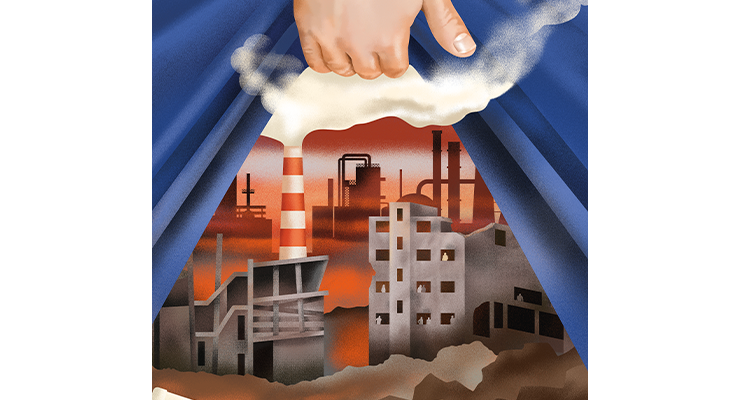
Transparency about the exploitation and environmental destruction involved in products – another thing which supply chain laws provide. © Illustration: Alina Günter

In the name of uncompromising responsibility

“Human rights cannot wait!” commented ECCHR Legal Director Miriam Saage-Maaß on the EU Parliament's decision to suspend the Supply Chain Directive CSDDD’s entry into force until mid-2027 at the earliest. This postponement endangers people around the world who work under exploitative conditions for European profits. It also further contributes to the erosion of what human rights – and any rights-based society in general – are essentially about: their universal validity.


In other words, pesticides that are legally prohibited in the food of European consumers must not endanger those who grow this food. Occupational health and safety, taken as a given in European factories, does not become a dispensable luxury just because a production facility is located south of the equator. Nobody knows this better than our partners in the Global South.


There, workers, trade unionists and countless others continue to defend their rights – even when at odds with the political agenda of the future German coalition government or the business climate of the EU. It is also scarcely credible that multinational corporations, which effortlessly implement every new financial market regulation, are somehow overwhelmed by their human rights due diligence obligations. 


Numerous companies have long since prepared for the implementation of the EU supply chain regulation originally planned for this summer, without any whining about bureaucracy. Together with all those who take responsibility, we will continue to work to ensure that human rights are not sacrificed to the pursuit of profit or political calculations – and we will not let up. We are determined to use the supply chain law and all available instruments to work together with those affected and partners worldwide to counter exploitation by companies.

On the right side

As a supporting member of ECCHR, you make an important contribution to taking long-term, independent action against human rights violations – both here in Germany and in places often outside the media spotlight. Above all, however, you stand in solidarity with those affected and support their tireless fight for justice.

Donate now

BUSINESS AND HUMAN RIGHTS

Europe’s poisonous exports: India pesticide case continues

The use of hazardous pesticides in the EU and Switzerland has been prohibited for some years. Yet, despite their well-known devastating effects upon human health and the environment, many such chemicals are still widely exported to the rest of the world, particularly the Global South. After evidence emerged linking a wave of lethal poisonings in Yavatmal, India, in 2017 to the pesticide Polo, families of victims and one survivor took its manufacturer Syngenta to court in Switzerland in 2021, demanding that the Swiss firm pay compensation. The case has set a global precedent as the first civil lawsuit from the Global South against an agrochemical company in the Global North over pesticide poisonings. Recently, the court held an instruction hearing to determine how the case should proceed: it will soon either decide to initiate an assessment of the evidence or establish whether the requirements for the plaintiffs’ compensation claims have been met. In either case, the proceedings are finally moving forward.


More about the case

Yemen: Arms export secrecy leads to skyrocketing legal costs

An extended saga of administrative inaction and lack of transparency has forced three Yemeni plaintiffs to drop their case against German arms exports to the Saudi- and UAE-led military coalition. Coalition airstrikes visited untold suffering, death and destruction upon the civilian population in Yemen for roughly seven years. Thus in 2021, with ECCHR and Mwatana, the plaintiffs brought their case to the German authority BAFA to contest export licenses for military equipment used in the air war. Though rejected after two years of stalling, they appealed the case in court last May and finally gained access to important files on the licenses. However, all critical information had been redacted – including which export licenses were linked to their case. Hence, the court decided it would assess all potentially relevant licenses, dramatically increasing legal costs. In light of such incalculable financial risk, the plaintiffs had to cease their legal efforts. This is a case in point of how state secrecy not only blocks access to legal protection, but also makes it near impossible to assess the legality of arms exports.


More about the case

German supermarket turns blind eye to the harms of its palm oil

The German supermarket chain Edeka has known of human rights violations in its palm oil supply chain in Guatemala since at least 2019. Nonetheless, it failed to address this even after it received a complaint in January 2024 alleging that its supplier NaturAceites engages in land grabbing, low wages, and contamination of the drinking water. Thus, members of affected indigenous communities in Guatemala, with the support of foodwatch and ECCHR, filed a complaint under the German Supply Chain Act. The law stipulates that Edeka must consult with the affected communities to remedy the situation, but thus far, the company has not sought out contact.


More about the case

INTERNATIONAL CRIMES AND ACCOUNTABILITY

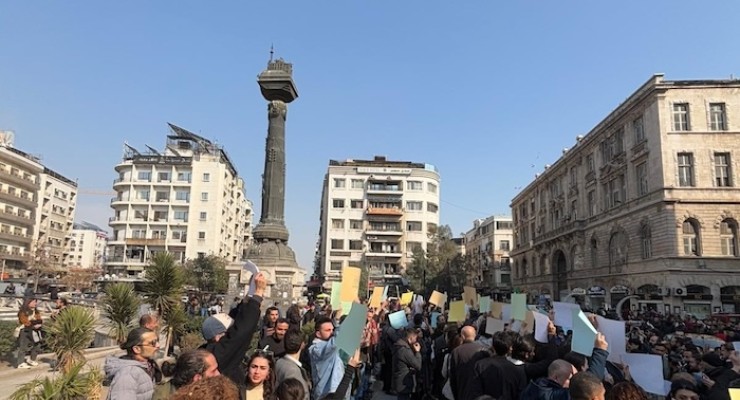
Demonstration in Damascus demanding an end to the killing of civilians in the coastal region. © Joumana Seif


Letter from Damascus #2

In her second “Letter from Damascus,” after returning from 12 years in exile, human rights lawyer and ECCHR Legal Advisor Joumana Seif reports on the rapid changes in Syria during the past weeks. She assesses the state of Syria’s political and constitutional transition process, the historic agreement with the Syrian Democratic Forces, the devastating violence and massacres in the coastal region, and the dire economic situation of the country. Joumana Seif will continue to report from Syria at regular intervals, focusing on the country’s political transition and how the process of seeking truth and accountability for dictatorship crimes is advancing.


Read Letter from Damascus #2

A blow to international law

Israeli Prime Minister Netanyahu's visit to Hungary is a blow to international law. An EU state that leaves the ICC and simultaneously welcomes suspected war criminals, despite an arrest warrant from the International Criminal Court (ICC), calls into question the credibility of international criminal justice. “Anyone who today looks the other way as Orban undermines international law will tomorrow have to watch others follow suit,” warns ECCHR Alexander Schwarz (ECCHR).


Our Q&A provides an overview of the legal basis of arrest warrants, the jurisdiction of the ICC, the importance of the principle of complementarity, and the obligations of member states such as Germany under international law – especially at a time when political realities are increasingly colliding with demands for justice.


Read the Q&A

Read our Open Letter (only available in German) on the protection of international law in the new German government’s coalition agreement

BORDER JUSTICE

The intentional obstruction of evidence in pushback cases

Pushbacks aim at keeping people outside the protection of the law and operate using a secret, informal modus operandi. This systematic practice also intentionally obstructs the creation and preservation of evidence – for example, in cases where no official records are kept of the handling of people on the move and their mobile phones are seized and destroyed. The cases of A.A.N. and Others v Greece before the European Court Human of Rights concern exactly these issues. A group of primarily Syrian nationals, apprehended on the Greek island of Symi, were detained in a remote location, had their phones confiscated, and were forced by masked officers onto a life raft in the middle of the sea. One person was further subjected to a chain pushback back to Syria. With the support of Refugee Support Aegean and Pro ASYL, ECCHR submitted a third-party intervention to the court concerning the intentional lack of evidence and lack of effective investigations.


Read the third-party intervention

INSTITUTE FOR LEGAL INTERVENTION

Spotlight Argentina: Lighthouses of resistance 

In multiple countries, a chilling phenomenon is on the rise, where politicians and the media deny or attempt to justify human rights violations. As part of ECCHR’s Living Open Archive, this spotlight examines the ongoing struggle for truth, memory and justice by Argentine civil society actors and their transnational allies. In the midst of the Milei government’s crackdown on official memory culture and the processing of the crimes of the military dictatorship, these alliances face extreme pressure, necessitating new long-term strategies based on international solidarity. This multimedia long read also sheds lights on the deep-rooted connections between the far right in Argentina and in Germany, showing how these links continue to undermine the pursuit of justice and accountability.


Visit the Living Open Archive

ECCHR

ECCHR 2024 Annual Report release in May

In addition to providing an overview of our work in 2024, this annual report looks at the growing global backlash against civil society engagement and progressive politics from neoliberal and authoritarian forces – along with strategies to resist it.


Please write an email at presse@ecchr.eu to receive a print version in your mailbox.


The digital version will soon be accessible here

© Pavel1964/Canva

The ECCHR running team at the Berlin Half Marathon 2025

The Berlin Half Marathon 2025 is finished – and our running team performed magnificently. We are still overwhelmed by the energy, enthusiasm and commitment of our runners. It was inspiring to see how many people came out together to run for human rights and send out a strong signal for justice.


A huge thank you to everyone who ran, supported us on and cheered us on! Because it was so great, we will be back again in 2026. Information soon to follow.

EVENTS

How the internet can help bring war criminals to justice

Open source research – the search for videos, photos and audio recordings on the internet and social media – can help to bring crimes to light. For example, we have used it in proceedings against pushbacks, in the case of the Russian bombing of the theater in Mariupol, and in our work to address crimes in Syria. This has given us valuable insights into the factors that determine whether courts recognize evidence from the internet. Arne Bardelle (ECCHR) will discuss this at this year's taz lab with Haneen Kebrith (Mnemonic/Syrian Archive) and Christian Mamo (OSINT for Ukraine).


26.04.2025, 9:00 am, frizzforum, Friedrichstraße 23, 10969 Berlin


More info

Say nothing. See nothing. Hear nothing.

Writer Kathrin Rögalla sees the development of public social discourse as a “war of noise,” in which both basic democratic values and careful language are being damaged. She has written a book on the subject and will discuss it with Wolfgang Kaleck (ECCHR) and journalist Ulrich Noller.


28.04.2025, 7:30 pm, Literaturhaus Köln, Großer Griechenmarkt 39, 50676 Köln 


More info

Anti-discrimination revisited – Paradoxical entanglements

Whether for trans people or groups affected by racism, the discrediting of hard-won anti-discrimination policies is increasingly part of the right-wing authoritarian agenda – and not just in the USA. At the same time, however, authoritarian rulers are not above invoking “protection from discrimination” as a means of silencing their critics. In the German-speaking context, accusations of anti-Semitism are also being appropriated to prevent criticism of current war crimes and violations of international law. Wolfgang Kaleck (ECCHR) addresses the new questions this raises for anti-discrimination policy with Deborah Feldman (author of Judenfetisch), Monika Mokre (political scientist and migration policy activist) and Isabel Frey (founder of Standing Together Vienna).


8.5.2025, 6:00 pm, Universität für Musik und darstellende Kunst, Anton-von-Webern-Platz 1, Vienna


More info

On Justice #4: Restructuring the rule of law by the right

The rule of law – long seen as a guarantor of freedom, equality and the containment of political power – is increasingly targeted by political attempts to reshape it. In Europe and worldwide, there is a growing movement on the right that does not aim for an open break with the principles of the rule of law but, rather, for a creeping restructuring of the constitutional state from within. The fourth edition of the HAU discussion series “On Justice” sheds light on how right-wing actors are reinterpreting the rule of law and instrumentalizing it for their own purposes. The focus is on the targeted undermining of democratic principles, particularly with regard to migration, as well as strategies for defending the liberal rule of law.


21.5.2025, 7:00 pm, HAU1 Hebbel am Ufer, Stresemannstraße 29, 10963 Berlin 


More info

Lawyers as gatekeepers – Between ethics and the rule of law

Laws that influence government action or corporate business models are rarely tacitly obeyed – even when passed by democratically elected bodies for good reasons. At the moment, this is particularly evident in Europe and Germany in the case of supply chain regulations, but resistance by interested parties against sanctions regulations or anti-money laundering laws can also clearly be seen. The pressure they mount also increasingly affects lawyers who work in politically controversial areas. How they can fulfill both their ethical obligations and uphold the rule of law is the topic of an expert discussion with Miriam Saage-Maaß (ECCHR), Prof. Dr. Matthias Kilian (Director of the Institute for Lawyers' Law at the University of Cologne) and Prof. Dr. Jonathan Soeharno (University of Amsterdam) at the annual conference of the German Bar Association. 


5.6.2025, 11:00 am, ECC Estrel Congress Center, Sonnenallee 225, 12057 Berlin


More info and registration

German arms exports to Israel

The current war in Gaza raises urgent questions about the legality of German arms exports to Israel. The Israeli military operations in the Gaza Strip after 7 October 2023 have caused a humanitarian crisis of historic proportions. The extensively documented attacks on civilian facilities, as well as the widespread destruction of civilian infrastructure, have killed tens of thousands of Palestinians and destroyed the livelihoods of the survivors for years. As part of the conference “UpRight – Solidarity in times of authoritarianism,” Alexander Schwarz (ECCHR) joins Lisa Wiese (researcher, Leipzig University) in a discussion on ECCHR’s casework against German arms exports to Israel and the legal dimensions of the war in Gaza.


14.6.2025, 5:00 pm, Campus of the Faculty of Sports Science at Leipzig University, Jahnallee, Leipzig


More info and registration

FOR GLOBAL JUSTICE

The world can only be just when human rights are universally recognized and guaranteed for everyone. This is what we are fighting for across the globe:
with those affected, with partners, with legal means.
Thank you for helping us in our efforts to make this happen.

Donate now

PAST EVENTS

Double standards in international law

At The New School in New York, Wolfgang Kaleck (ECCHR) gave a talk on international law and double standards in relation to Russia, Syria and Israel. The discussion also examined the role of transnational corporations in human rights abuses. The New School regularly hosts events with important guests from all over the world, advocating change through interdisciplinary means of inquiry from artists, politicians and researchers alike. The event was part of the series Decolonizing International Affairs.


More about the event and panelists

On Justice #3 – My Body, my Rights

By the time they become pregnant, at the latest, women learn that self-determination over their own bodies still cannot be taken as a given. Worldwide, 111 million women live in countries where abortion is not legal under any circumstances. A further 662 million are only allowed to have an abortion if their life or health would otherwise be at risk. Even where abortion is legal, the necessary facilities are coming under increasing threat from right-wing politics. As part of this event series co-organized by ECCHR, activists and lawyers discussed current successes and setbacks in the fight for a right that the majority of European civil society continues to take for granted.


More about the event series

The economy of violence: The case of Argentina

On 24 March 1976, the Argentine military dictatorship seized power. Approximately 30,000 people disappeared in secret torture camps, while hundreds of thousands were tortured or driven into exile. Under Milei's authoritarian neoliberal government, the hard-won reappraisal of these crimes is in danger. With his chainsaw, he is not only dismantling the welfare state, but also the culture of remembrance. On the 49th anniversary of the military coup, we thus came together to discuss the history and future of the ongoing struggle for truth, memory and justice in Argentine society. At the same time, tens of thousands demonstrated on the streets of Argentina, united under the slogan “Nunca más” for remembrance and against the Milei‘s system – impressive images that we were able to follow live from Berlin.


More about the event and panelists

Defending human rights at Hertie's Centre for Fundamental Rights

To discuss the legal, political and social pressures facing human rights defenders in Germany and abroad, Hanaa Hakiki (ECCHR) joined Mary Lawlor, Special Rapporteur on the situation of human rights defenders, Luise Amtsberg, the Federal Government Commissioner for Human Rights Policy and Carla Hinrichs, a Last Generation climate protection activist.


Watch the footage

The principle of universal jurisdiction: On the road to justice 

For 20 years now, states have been able to prosecute international crimes even if they were not committed on their territory and do not directly involve their citizens. Germany has so far played an important, pioneering role in the application and further development of the principle of universal jurisdiction, including with the Koblenz trial against high-ranking perpetrators of the Assad regime, in which ECCHR was also involved. In the future, care must be taken to avoid double standards, said Andreas Schüller (ECCHR) at a panel discussion organized by the Konrad Adenauer Foundation.


More about the event and panelists

Accountability for Crimes against Migrants

Sub-Saharan migrants are regularly and systemically abused by security forces in North Africa – and the EU continues to provide financial support and equipment to these security forces. In many cases, these abuses amount to crimes against humanity, and thus far, no one has been held accountable for them. In a side event at the 58th session of the UN Human Rights council, co-sponsored by ECCHR, five experts, including our partner David Yambio (Refugees in Libya), addressed this grave impunity.


More about the event and panelists

Review of the Rome Statute of the International Criminal Court: Strengthening the Court’s Jurisdiction for the Crime of Aggression

As part of a series of regional conferences in Africa, Latin America and Asia, organized by the German Ministry of Foreign Affairs with the support of both the Polish and Estonian Ministries of Foreign Affairs, this conference in São Paulo, Brazil, in March brought together legal experts, including Isabelle Hassfurther (ECCHR), to discuss the expansion of the ICC’s jurisdiction over the crime of aggression.


More about the event and panelists

Migration narratives: Trapped in racism and colonialism?

Hanaa Hakiki (ECCHR) discussed narratives of migration with Professor Aghogho Akpome, Sandra Alloush and Musa Okwonga. The central question was whether it is possible to speak of “migration” outside of a colonial and racist framework. Panelists and audience alike shared personal stories of mobility between borders and opened up radical possibilities for thinking about universal human rights beyond the deficit-oriented narratives and language of migration.

What’s next for globalization?

The fact that business and politics can quickly adapt to changes in international production and trade conditions is currently illustrated by the reactions to the US government's import tariffs. All the more questionable is the inability to implement something that has been claimed for years – the protection of human rights along supply chains. Miriam Saage-Maaß (ECCHR) spoke about this with Melanie Müller (Stiftung Wissenschaft und Politik) at the Open Society Forum at this year's Leipzig Book Fair.


More about the event and panelists

PUBLICATIONS

ECCHR, REDRESS, Civitas Maxima, CJA, FIDH, and TRIAL International

Universal Jurisdiction Annual Review 2025

TRIAL International, 2025


Alexander Schwarz

Netanyahu in Hungary: Staging a breach of the law (only available in German)

Table Media, 31 March 2025


Wolfgang Kaleck
International law versus good business
Berlin Review No 9, March 2025


Miriam Saage-Maaß and Katharina Reuter 
Human rights are not bureaucracy (only available in German)
Tagesspiegel Background, 20 February 2025


Arne Bardelle and Arie Mora
“No safe haven” is not enough – universal jurisdiction and Russia’s war of aggression

EJIL:Talk!, 26 February 2025


Edeka pilloried for palm oil (only available in German)
Spiegel, 28 February 2025


Joumana Seif
"We are prepared" (only available in German)
Medico international, 3 March 2025


Case report: Challenging arms exports to Israel

ECCHR, March 2025


Judith Hackmack and Sarah Imani 

Reparations for European Colonialism: From the Movement to the Law and Back?

The Global Community Yearbook of International Law and Jurisprudence, November 2024


Kalika Mehta, Sarah Imani and Leokadia Melchior 

Prosecutions Across Borders: A TWAIL Review of Universal Jurisdiction Practice: The Case of Germany 

Journal of International Criminal Justice, December 2024 


Sarah Imani and Elise Pape

The (Non)Recognition of the Herero and Nama Genocide: Transnational Struggles for Restorative Justice and Reparations

Journal of Contemporary History, January 2025.


Sarah Imani 

Reparations as postcolonial international criminal law (only available in German), in: M. Abraham/ G. Stefanopoulou (Eds.) Postcolonial Internation Criminal Law?

Nomos, March 2025

PODCAST/VIDEO

Wolfgang Kaleck

War crimes in the Ukraine – How much power does international law have? (Only available in German)

BR Kulturleben, 10 April 2025


Wolfgang Kaleck
Interview with Thilo Jung
Jung & Naiv, 20 February 2025


Wolfgang Kaleck
Human Rights Attorney Wolfgang Kaleck on Double Standards in International Law, from Russia to U.S.
Democracy now, 21 March 2025


Joumana Seif

Statement at UN Security Council (from min. 46:40)

United Nations (or Webtv.un), 25 March 2025

Let's stay in touch!

+49 (0)30 69506023          newsletter@ecchr.eu

ECCHR

EUROPEAN CENTER FOR CONSTITUTIONAL AND HUMAN RIGHTS
Zossener Straße 55 – 58
D – 10961 Berlin

+ 49 30 400 485 90
info@ecchr.eu

If you no longer wish to receive this email, you can unsubscribe here. 

twitter facebook instagram linkedin youtube

Bank details
Name: ECCHR
Bank: Berliner Volksbank
IBAN: DE77 100 90000 885360 7011
BIC: BEVODEBB

Further information on data protection and imprint.