View in browser

COMPLAINT AGAINST RUSSIAN MILITARY. ONE YEAR SINCE MELILLA. JUSTICE FOR YEMENIS.

JULY 2023 | NEWSLETTER 91

In the war against Ukraine, Russian forces often direct their aggression against civilians through bombing campaigns, executions, torture and sexual violence. These crimes are not simply a collection of haphazard acts of violence by individual soldiers and, rather, must be seen for what they are: a widespread and systematic attack on the Ukrainian civilian population – in other words, a crime against humanity.


In support of an Ukrainian survivor of sexual violence, ECCHR and Ukrainian Legal Advisory Group (ULAG) recently filed a criminal complaint with the German Federal Public Prosecutor demanding investigations into her case and the widespread nature of these crimes. Read more about this case and others in this newsletter.


The ECCHR Team

Ukrainian survivor of sexual violence calls for investigations into higher-ranking perpetrators

In June, ECCHR and ULAG filed a criminal complaint in Germany under the principle of universal jurisdiction against two members of the Russian military and two of their superiors. With the complaint, both organizations are supporting a survivor who was raped by the Russian soldiers. The complaint aims to counteract gaps in Ukrainian law and hold all perpetrators – including commanders – to account.


Although in absentia proceedings against one of the alleged perpetrators have already been initiated, a comprehensive criminal prosecution in Ukraine is currently not possible. The ongoing war severely inhibits investigative efforts, while Ukrainian law also lacks two crucial features. On the one hand, crimes against humanity are not punishable in Ukraine. On the other, the law does not recognize the principle of “command responsibility,” i.e. the responsibility of commanding officers for the actions of their subordinates. This principle entails that high-ranking military personnel are also liable for such crimes if they knew, or must have known, of them and still failed to prevent them.


Such war crimes are not isolated incidents: as of June 2023, investigations were opened in Ukraine into 208 cases of conflict-related sexual violence (CRSV). The number of unreported cases of CRSV is, however, likely far greater. CRSV is too often fostered by the inaction of commanders, which is why command responsibility is crucial in preventing impunity.


More about the case

BUSINESS AND HUMAN RIGHTS

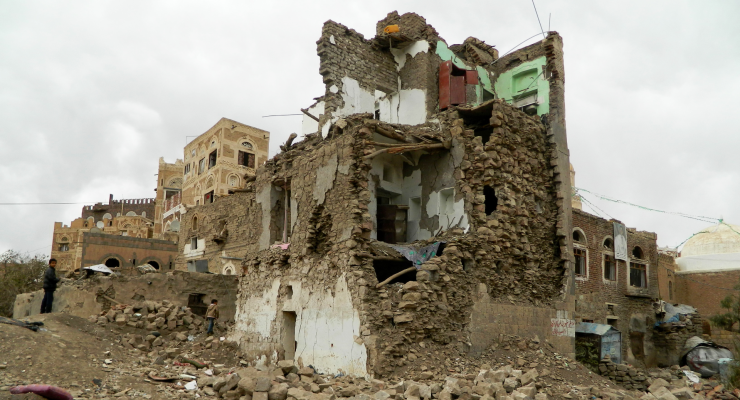
The wreckage of a bomb blast in al Foulaihy neighorhood in Yemen. © Photo: Mwatana

Unprecedented chance for European Court of Human Rights to deliver justice to Yemenis

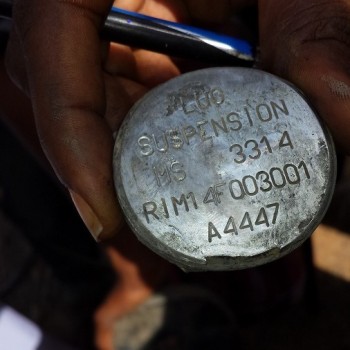
Two relatives of victims and one survivor of a deadly airstrike in Yemen submitted a complaint against Italy with the European Court of Human Rights (ECtHR) with the support of ECCHR, Mwatana for Human Rights and Rete Pace e Disarmo. In October 2016, an unlawful airstrike conducted by the Saudi-led military coalition using Italian-made bombs on the village Deir Al-Ḩajārī killed six members of the Husni family and injured others. Remnants found at the site of the attack confirmed that the bombs used were manufactured by RWM Italia, a subsidiary of the firm German Rheinmetall AG. Italian officials had authorized the export of these weapons to Saudi Arabia and United Arab Emirates for a prolonged period of time – in violation of the Arms Trade Treaty. Now, the ECtHR has the unprecedented opportunity to ensure that European states provide access to justice for victims of war crimes committed with weapons produced in Europe.


More about the case

INTERNATIONAL CRIMES AND ACCOUNTABILITY

Setback for sea rescue defendants in Italy

The saga of the criminalization of sea rescue in Italy has advanced with a rather alarming decision by the judge, who refused to review the constitutional legitimacy of the crime of “facilitating irregular entry” of migrants and refugees into the country. Italian and EU legal frameworks prohibiting “facilitation” have been consistently used to justify the criminalization of humanitarian assistance and solidarity with people on the move. According to Francesca Cancellaro, defense lawyer for the Iuventa crew, “We wanted the high courts to decide once and for all on the balance between border protection and the protection of human beings. But the judge denied Iuventa and everyone this possibility. The decision is unsatisfactory as much for the outcome as for the arguments that support it, but we will certainly not stop here. The challenging of the European and Italian discipline on facilitating irregular migration will continue in the courtrooms.”


Read the trial monitoring report

25 years of the Rome Statute – Revisiting the crime of aggression

After two UN ad hoc criminal tribunals on the conflicts in ex-Yugoslavia and Rwanda in the 1990s, there were calls from civil society, academics and states to create a permanent international criminal court. In Rome in 1998, negotiations between states finally took place, resulting in the Rome Statute, which came into force in 2002 with the establishment of the International Criminal Court (ICC).


As a major milestone in international criminal justice, the ICC has made significant advances over the last two decades, yet there remain aspects of the statute where reform would be welcomed. For example, regarding the crime of aggression – one of the core crimes against international law, which has been recently committed by Russia in its war against Ukraine – the statute should be adapted to implement the same rules of jurisdiction that are applied for the other three core crimes. This would mean that, even if the aggressor state does not grant its consent, these crimes could still be prosecuted at the ICC. In addition, the statute should also allow for judicial review of decisions by the Office of the Prosecutor not to pursue an investigation when victims or NGOs file cases, since the prosecuting authority often dismisses complaints without providing any justification.


Read more about international criminal justice and the crime of aggression against Ukraine

Made in Europe, bombed in Yemen

While European countries may publicly condemn the war in Yemen, some have failed to prevent the export of European weapons, which have led to untold civilian casualties. ECCHR fights against double standards when it comes to the export of European weapons to conflict regions.

Donate now

BORDER JUSTICE

Melilla: A year without justice, a year of impunity

A year ago on 24 June, Black asylum seekers crossing the Spanish-Moroccan border were met with deadly violence. During the Melilla massacre, 36 died, 76 went missing and 470 were expelled. This June, along with more than 300 NGOs, ECCHR co-signed a manifesto demanding an independent and effective investigation, the provision of mechanisms for families to identify loved ones and search for the disappeared, and that Spain end its regime of authorizing pushbacks from Ceuta and Melilla.


Read the manifesto

ECCHR

Two open administrative positions at ECCHR

ECCHR is currently looking to fill two administrative positions: Head of Human Resources and Head of Finances and Adminstration. Please visit this page (only available in German) to see the job descriptions.

ECCHR welcomes new trainees

Philipp Eschenhagen, Rebecca Militz, Lisa Pitz and Vera Bannhagel joined the Business and Human Rights team in July as trainees


Anafee Fränznick joined the Border Justice team in July as trainee 


Anna Reichling joined the Communications and Fundraising team in July as a trainee

FOR GLOBAL JUSTICE

The world can only be just when human rights are universally recognized and guaranteed for everyone. This is what we are fighting for across the globe:
with those affected, with partners, with legal means.
Thank you for helping us in our efforts to make this happenen.

Donate now

PAST EVENTS

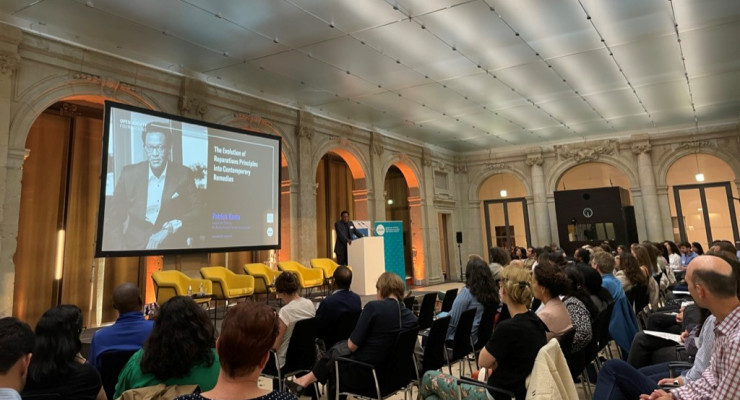
Patrick Kauta, visible on the screen, began the conference by speaking about his work for representatives of the Herero and Nama on questions of reparations in Namibia. © ECCHR

The Evolution of Reparations Principles into Contemporary Remedies

Organized in partnership with Open Society Justice Initiative and Human Rights Watch, this event brought together human rights defenders from across the globe, including the lead attorney for Herero and Nama representatives Patrick Kauta, lead defense counsel at the International Criminal Cout Charles A. Taku and ECCHR’s Wolfgang Kaleck and Sarah Imani, among others. Spotlighting interventions in Namibia, Tanzania and Germany, the panel discussions focused on the limited legal avenues available for victims and survivors of colonial crimes against humanity, as well as for their descendants who still endure the harmful repercussions of such crimes today. To contextualize the philosophical and moral debates on reparations in Germany, participants explored the evolution of the basic legal right to reparations, the barriers that petitioners from the Global South must overcome, and new efforts by advocates and academics to “decolonize” international human rights law itself.


Watch the footage


More about our work on colonial crimes and reparations

PODCAST

Andreas Schüller

“How can NGOs protect constitutional and human rights?”

Just Access, podcast episode 16, 10 July 2023


Let's stay in touch!

+49 (0)30 69506023          newsletter@ecchr.eu

ECCHR

EUROPEAN CENTER FOR CONSTITUTIONAL AND HUMAN RIGHTS
Zossener Straße 55 – 58
D – 10961 Berlin

+ 49 30 400 485 90
info@ecchr.eu

If you no longer wish to receive this email, you can unsubscribe here. 

twitter facebook instagram linkedin youtube

Bank details
Name: ECCHR
Bank: Berliner Volksbank
IBAN: DE77 100 90000 885360 7011
BIC: BEVODEBB

Further information on data protection and imprint.