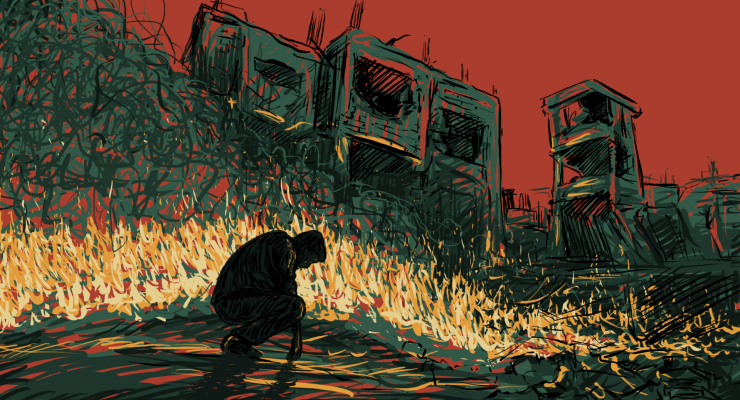
This question is as old as humanity itself. Even in Thucydides, law does not appear as an independent normative authority but, rather, as something dependent on other existing power structures. Today, even though long praised as a guarantor of the rule of law in Western democracies, the separation of powers is increasingly revealing its limitations. This is particularly evident where human rights are violated beyond the borders of a nation-state’s territory: rights that exist on paper are hardly enforceable in practice. A striking example is the decision by Germany’s supreme court not to accept the complaint from Abed J., a Palestinian living in Gaza, who had challenged German arms exports to Israel. "The Court acknowledges protection duties on paper but refuses their practical enforcement. For people whose lives are threatened by German arms exports, legal recourse is effectively denied," criticizes Dr. Alexander Schwarz.
The contrast is especially striking in light of the Rammstein decision by the Federal Constitutional Court last summer. The court had recognized that Germany has fundamental protective obligations that reach beyond its borders. This responsibility also entails refraining from exporting weapons whenever there is an above-average risk of facilitating violations of International Humanitarian Law.
Instead of examining this obligation, the Court took an opportunistic position that combined Staatsräson und the Zeitenwende (referring to Germany’s recent broader shift toward militarization and expanded security policy), presuming without question that the government and authorities were following the rules.
"Compared to other industries, the arms trade is closely linked to national security and is therefore often shielded from legal disputes," write Cannelle Lavite and her co-authors in the special issue of Business and Human Rights, describing the situation as “normal.” As early as 2022, the UN Working Group on Business and Human Rights noted that the arms sector has a “symbiotic relationship” with its countries of origin, characterized by a “blurring of the lines between state and arms industry.” The convergence of state and corporate interests within a loose regulatory framework and a “culture of secrecy” effectively nullifies accountability to victims.
For Abed J. and countless other civilians worldwide, this situation is life-threatening. For the rest of us, it should be deeply concerning. If even the courts fail to exercise their oversight, who will defend the law?
We keep you regularly informed about our case work on Israel and Palestine in a special newsletter series. Sign up here for these updates.
|